
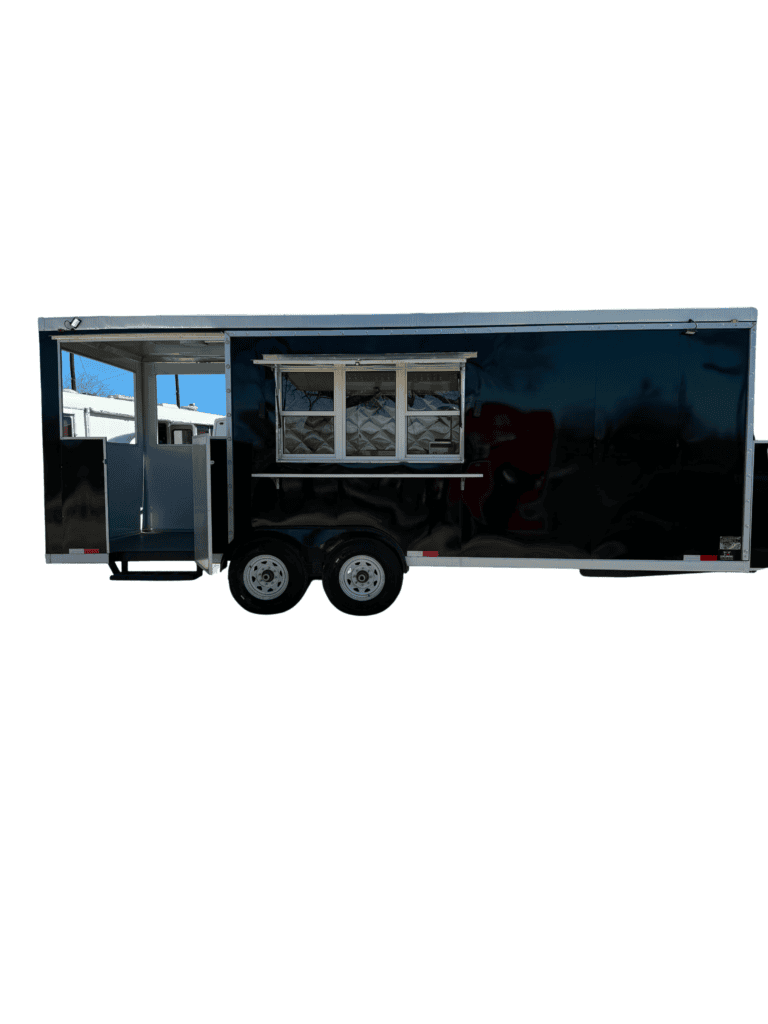
Quick answer: On the open market, most food trailers cost between $20,000 and $120,000 in 2026, depending on size and equipment (used trailers run $6,000–$40,000). At Oswide, our custom, imported-to-the-U.S. builds start around $15,000 before customizations — often below typical market prices — so what you pay depends mainly on the features you add.
Starting a mobile food business is one of the most affordable ways to break into the food industry — but it’s still a real investment. Below, we break down where your money goes, how financing works, how long a custom build takes, and the permit costs you’ll face in South Carolina, North Carolina, and Georgia.
What Determines the Price of a Food Trailer?
Size & layout
Most food trailers run 14–24 feet, with 16–22 ft being the sweet spot. As a rule of thumb, every extra foot of length adds roughly $2,000–$3,000 before equipment.
Kitchen equipment & appliances
Usually the largest chunk of the budget — often 30–40% of the total build. Commercial-grade gear costs more than consumer equipment, but lasts far longer.
Ventilation, hood & fire suppression
If you cook with grease or open flame, you’ll need a commercial exhaust hood with a fire-suppression system — roughly $4,700–$8,000, and a code requirement in most areas.
Customization, branding & wraps
A full vinyl wrap typically costs $2,500–$6,000; partial wraps and spot graphics cost less ($500–$3,000).
Power, water & utilities
A commercial-grade generator sized for a full cook line runs about $3,000–$6,000. Add water tanks, a heater, and electrical, and utilities become a meaningful line item.
New vs. Used Food Trailers: Which Is Actually Cheaper?
A used trailer looks cheaper on the sticker — but the savings can evaporate fast.
- The hidden cost of used: older trailers often need retrofits to pass today’s health and fire codes, and you inherit worn equipment with no warranty.
- When used makes sense: a recently-built unit that already meets your local code and fits your menu can be a smart entry point.
- When it doesn’t: for a specific menu or long-term business, a purpose-built trailer usually pays back faster.
Custom-Built vs. Off-the-Lot: What You Get for the Money
A custom build is designed around your menu and workflow — less wasted motion, faster service, equipment exactly where you need it.
At Oswide, we build custom trailers from scratch at our dedicated partner facility and import them to the U.S. — which lets us start builds around $15,000 and let you spend the rest of your budget on exactly the equipment and finishes your menu needs. You tell us your vision; we engineer it to code and to your budget.
How Long Does It Take to Build a Custom Food Trailer?
This is where most buyers get surprised. Across the industry, a custom food trailer typically takes 3–4 months to build.
Oswide delivers custom builds in approximately one month — a real advantage when you’re eager to start earning. If you already like one of our existing models, delivery can be as quick as 1–2 weeks.
Can You Finance a Food Trailer? (Yes — Here’s How)
You don’t need the full purchase price in cash. Food trailers are commonly financed through equipment loans, lease-to-own agreements, and SBA microloans.
At Oswide, we make it simple: financing starts with a minimum $10,000 down payment, and your exact down payment is based on your trailer’s final price — so a more customized build may require a bit more down. From there, you spread the balance into manageable monthly payments instead of paying it all upfront.
Licenses & Permits for Food Trailers in South Carolina, NC & Georgia
Permit rules trip up a lot of new operators — and they differ by state. The cleanest way to see the region: South Carolina permits through one state agency, while North Carolina and Georgia permit at the county level.
South Carolina
As of July 1, 2024, mobile food permitting moved from DHEC to the South Carolina Department of Agriculture (SCDA) under Regulation 61-25. (Many older guides still say “DHEC” — that’s outdated.)
- Permit: apply as a Retail Food Establishment + the Mobile Food supplemental form, ~30 days before opening
- Fees: roughly $100–$200/year (annual inspection fee is tiered by sales; startups fall in the lowest tier)
- Commissary required: signed agreement with a licensed commercial kitchen; return within 72 hours (self-contained) or 24 hours (non-self-contained)
- Certification: a Certified Food Protection Manager (ServSafe Manager, ~$125, valid 5 years)
- Also needed: a SC retail (sales tax) license from SCDOR and a local business license (varies by city, $50–$500)
North Carolina
- Permitted at the county level (rule 15A NCAC 18A .2600)
- Stricter commissary rule: return to your commissary every day of operation
- Permit cost: roughly $200–$600; plans must be approved before you build or buy
Georgia
- Statewide rules via the GA Dept. of Public Health, but your county of origin issues the permit
- Two permits: one for your base/commissary and one for the unit
- Reciprocity (since Jan 2023): your home-county permit is recognized elsewhere in GA, but you must request authorization to operate in each new county
County and city fees vary — always confirm with your specific local authority before budgeting.
Hidden & Ongoing Costs to Budget For
The trailer is just the start. Budget for:
- Insurance: ~$2,000–$10,000/year total (general liability + commercial auto, usually the biggest piece)
- Commissary rent: ~$300–$1,100/month depending on your market
- Permit renewals, POS system, generator fuel/propane, maintenance, and parking/storage
Food Trailer vs. Food Truck: Cost Comparison
| Food Trailer | Food Truck | |
|---|---|---|
| Typical cost | $20,000–$120,000 | $50,000–$200,000 |
| Engine/vehicle upkeep | None (you tow it) | Ongoing |
| Setup time on site | Slightly longer | Fast |
For most first-time owners, a trailer delivers the same kitchen for a lower total cost — you’re not paying for (or maintaining) a truck engine.
Is a Food Trailer a Good Investment?
With lower overhead than a brick-and-mortar restaurant, many food-trailer operators report recouping their investment within 6–18 months, depending on location, menu margins, and how often they operate.
The biggest lever is customer traffic — and that comes down to marketing. Our branding and marketing partner, XOriginals Partners, helps food-trailer owners build a standout brand, grow online, and get discovered by more customers — turning a great trailer into a busy one.
How to Get the Right Food Trailer for Your Budget
The smartest first step isn’t guessing at a number online — it’s getting a real quote built around your menu, your equipment, and your timeline.
Oswide builds custom food trailers for entrepreneurs across South Carolina, North Carolina, and Georgia, with fast turnaround and flexible financing.
Frequently Asked Questions
How much does it cost to build a custom food trailer from scratch?
At Oswide, custom builds start around $15,000 and rise with size and equipment. Get an exact quote for your specs.
Is a food trailer cheaper than a food truck?
Yes — trailers ($20k–$120k) generally cost less than trucks ($50k–$200k) and have no engine to maintain.
Can I finance a food trailer with bad credit?
Often yes — many lenders work with lower credit scores, usually with a higher down payment. Check your options on our Financing page.
How long does a custom food trailer take to build?
Industry average is 3–4 months; Oswide delivers custom builds in about one month.
Do I need a commissary for my food trailer?
In SC, NC, and GA, yes — you must be tied to a licensed commercial kitchen for water, waste, and storage.
How long do food trailers last?
A well-built, well-maintained trailer can last 10+ years.